Housing Supply Climbs to 4.9 Months as Existing-Home Sales Slip to 3.98 Million

The National Association of REALTORS reported on September 10, 2026 that existing-home sales ran at a seasonally adjusted annual rate of 3.98 million in August, down 2.0% from July and 1.2% from a year earlier. Unsold inventory reached 1.62 million units, up 5.9% from August 2025. At the current sales pace that equals 4.9 months of supply, compared with 4.6 months in both July and a year ago. The median existing-home price was $429,100, up 1.6% year over year.
Pace indicators point the same way. NAR put median days on market at 31 in August, up from 29 in July and unchanged from a year earlier. Redfin's four weeks ending September 13, published September 17, showed a median of 46 days on market, an average sale-to-list price ratio of 98.6% (up from 98.4%), and 20.8% of listings with a price drop, up from 19.7%. Seasonally adjusted pending sales fell 5.4% year over year to 299,126, which Redfin described as the lowest level in nearly three years. The two sources use different samples and methods, so absolute levels differ; the direction of travel is what matters here.
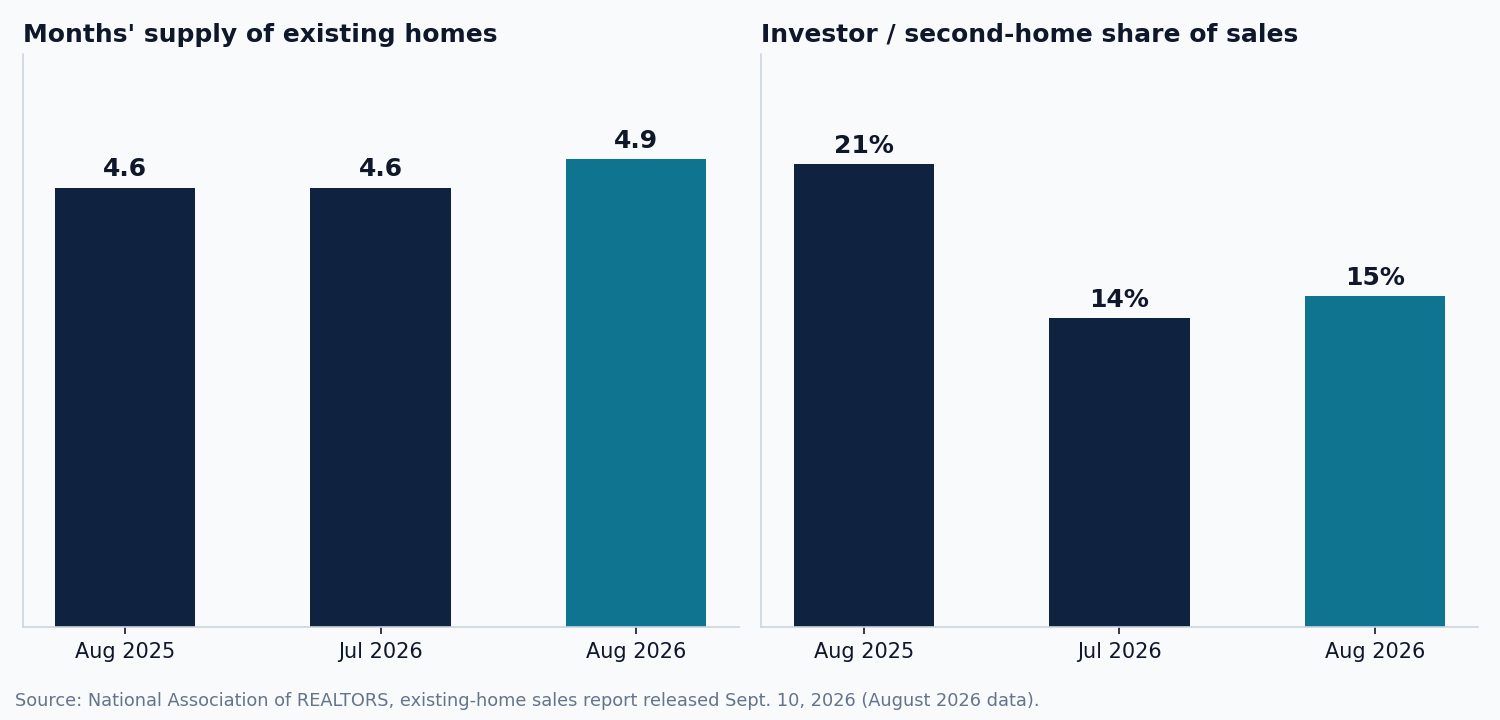
Investor demand is the notable divergence. NAR reported that individual investors and second-home buyers made up 15% of August transactions, up from 14% in July but down from 21% a year earlier. All-cash buyers accounted for 27% of sales, versus 28% a year ago. Regional pricing is also uneven: the Northeast median reached $556,900 (up 4.3% year over year) while the West median of $619,100 was down 0.2%, and Northeast sales fell 4.0% from July while West sales were unchanged.
Financing is the constraint that has tightened most recently. Freddie Mac's survey released October 1, 2026 put the average 30-year fixed rate at 7.28%, up from 7.03% the prior week and 6.34% a year earlier. A higher rate raises the monthly debt service in any coverage calculation, so a property that cleared a lender's threshold a few weeks ago may no longer do so, even when the seller is willing to negotiate.
For lenders, a market with rising supply and softer demand argues for closer attention to appraisal support and borrower liquidity, particularly in regions where prices are flat or falling. For investors, the data suggests patience and precision: rising inventory is an opening, but only for those who have already confirmed how much leverage a given property can carry.