DSCR Loans Start at 6.125% as Conventional Mortgages Reach 7.28%

Investors and lenders evaluating deals this week are working against a firm rate backdrop. Freddie Mac's weekly survey, released October 1, put the average 30-year fixed mortgage rate at 7.28%, up from 7.03% the prior week and 6.34% a year earlier. The 15-year average rose to 6.6%. By that measure, the 30-year rate sits at its highest level since November 2023, when it averaged 7.29%.
Rates for investor-focused DSCR loans are quoted on a different basis. A rate survey published by DSCR Authority and dated October 1, 2026 shows 30-year fixed DSCR pricing spanning roughly 6.125% to 7.375%, depending on credit tier, loan-to-value ratio, and debt service coverage ratio. A standard profile of a 720 FICO score, 75% LTV, and a DSCR between 1.00 and 1.24 anchors near 6.75%. The strongest tier, at 740+ FICO and a DSCR of 1.25 or higher, is quoted between 6.125% and 6.625%, while weaker profiles run from 6.875% to 7.375%.
These figures should not be read as a like-for-like comparison. The Freddie Mac number is a national average for conventional loans, while the DSCR figures are indicative quotes from a single rate table that vary by lender, prepayment terms, reserves, and loan size. An earlier survey from Sistar Mortgage, a June 2026 snapshot, described a wider spread of roughly 6.5% to 7% for strong borrowers and 7.75% or more for higher-risk profiles, which illustrates how much the quoted range depends on the source and the date.
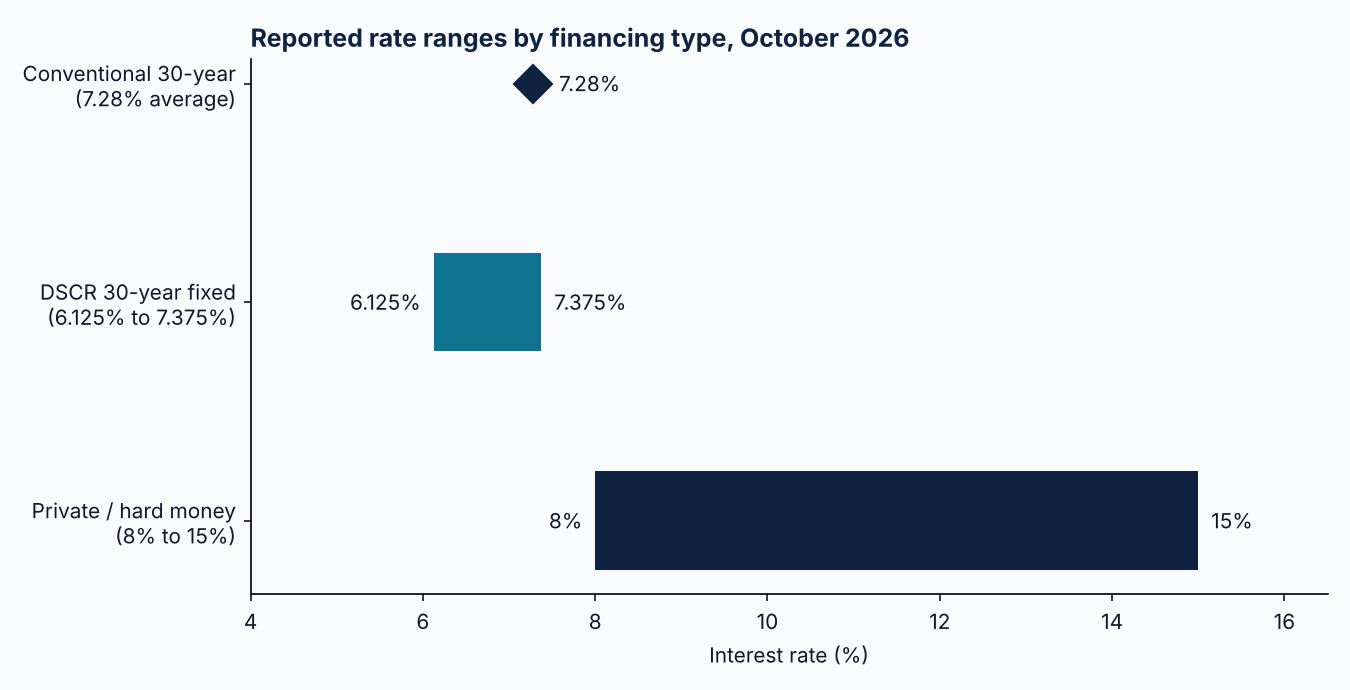
Private and bridge financing remains the most expensive option. Crestmont Capital reports that most hard money lenders price loans in an 8% to 15% range in 2026, with residential fix-and-flip loans typically at 9% to 12% and commercial bridge loans at 10% to 14%. Lenders commonly charge one to four origination points and rarely lend more than 65% to 75% of value. For a borrower choosing between a term product and short-duration capital, the gap in carrying cost is material and should be underwritten explicitly.
The macro calendar adds a further variable. The Federal Open Market Committee is scheduled to meet October 27 to 28, and rate-sensitive pricing may move around that decision. Deals that pencil only at today's quotes carry little margin for a repricing between application and closing.
The practical takeaway is to test each deal against a range of rates rather than a single quote. Investors who know their coverage and equity position in advance are better placed to select the right lender and structure, and lenders benefit from files that arrive already screened against realistic assumptions.